
Imagine you own a one-bedroom in Dubai and your agent says, "Enquiries are at an all-time high." Two sentences later, the same agent suggests trimming your asking rent. If demand is that strong, why is the price going down? That puzzle sits at the center of this week's data. Tenant interest reached a record in Q3, rents per square foot eased, the emirate's first-half GDP numbers landed, and the land registry logged another busy week. Note on dates: most figures come from the last seven days. A few earlier data points (the S&P Global PMI from 5 October and a July supply study) are included as background and dated in the text. This is general information, not financial advice.
At a glance
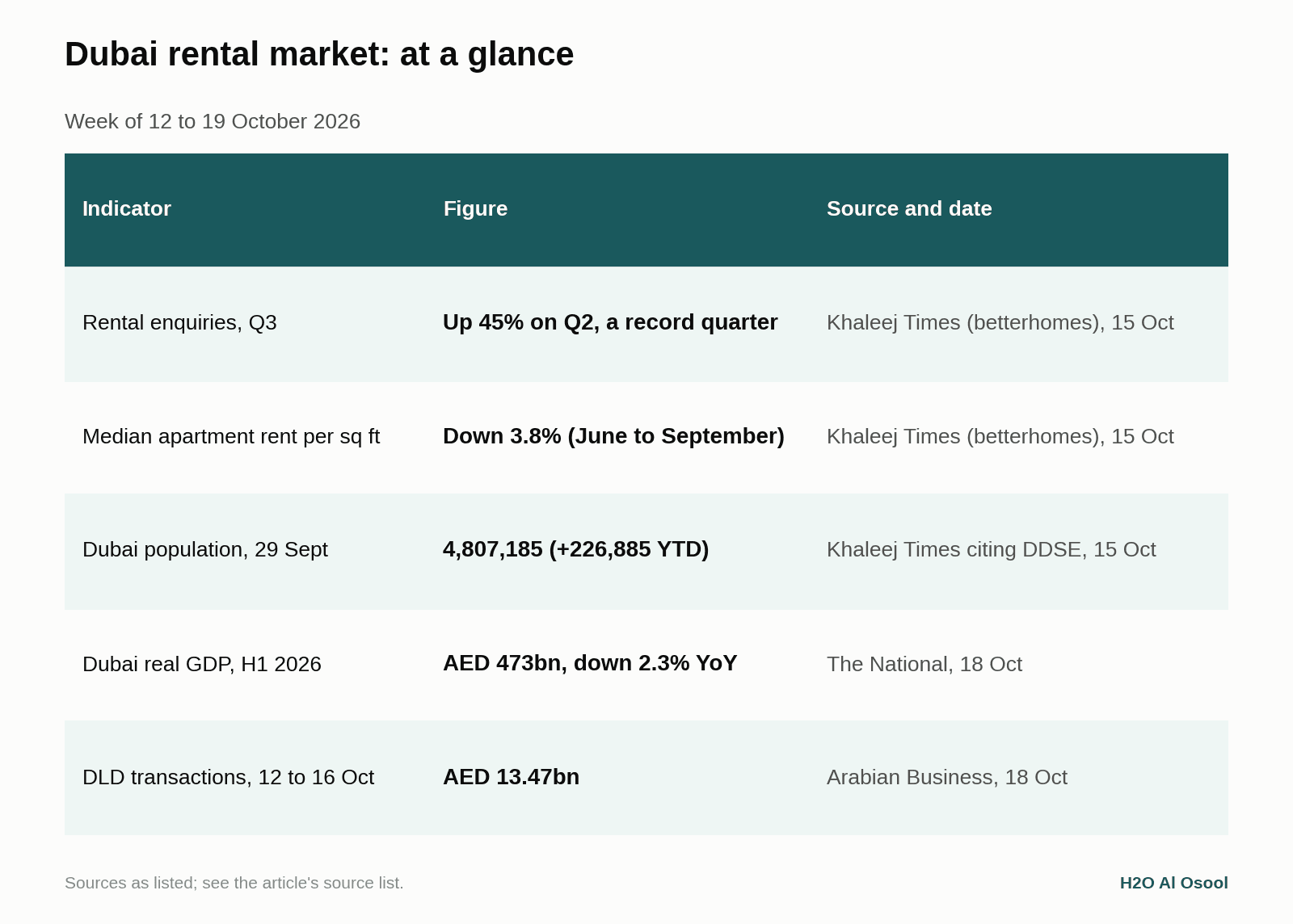
Rental enquiries in Q3 versus Q2, a record quarter, while median apartment rent per sq ft slipped 3.8% from June to September (betterhomes, 15 Oct).
1. The landlord's squeeze: record demand, softer rents
A betterhomes quarterly report, covered by Khaleej Times on 15 October, found rental enquiries rose 45% on Q2 and 15% on the same quarter last year, a record quarterly high. September alone was up 31% on September 2025. Yet median apartment rents per square foot fell 3.8% from June to September, and villa and townhouse rents fell 2.3%. Betterhomes' leasing manager Jacob Bramley said rents "became more competitive in parts of the market." Dubai's population stood at 4,807,185 on 29 September, up 226,885 since the start of the year, according to Dubai Data and Statistics Establishment figures cited in the same report. That works out to roughly 830 new residents a day, by our own arithmetic. More residents explain the enquiries. Rising supply explains why landlords have less pricing power: tenants can compare more buildings and negotiate.What betterhomes recorded
One reason: more people, but also more choice
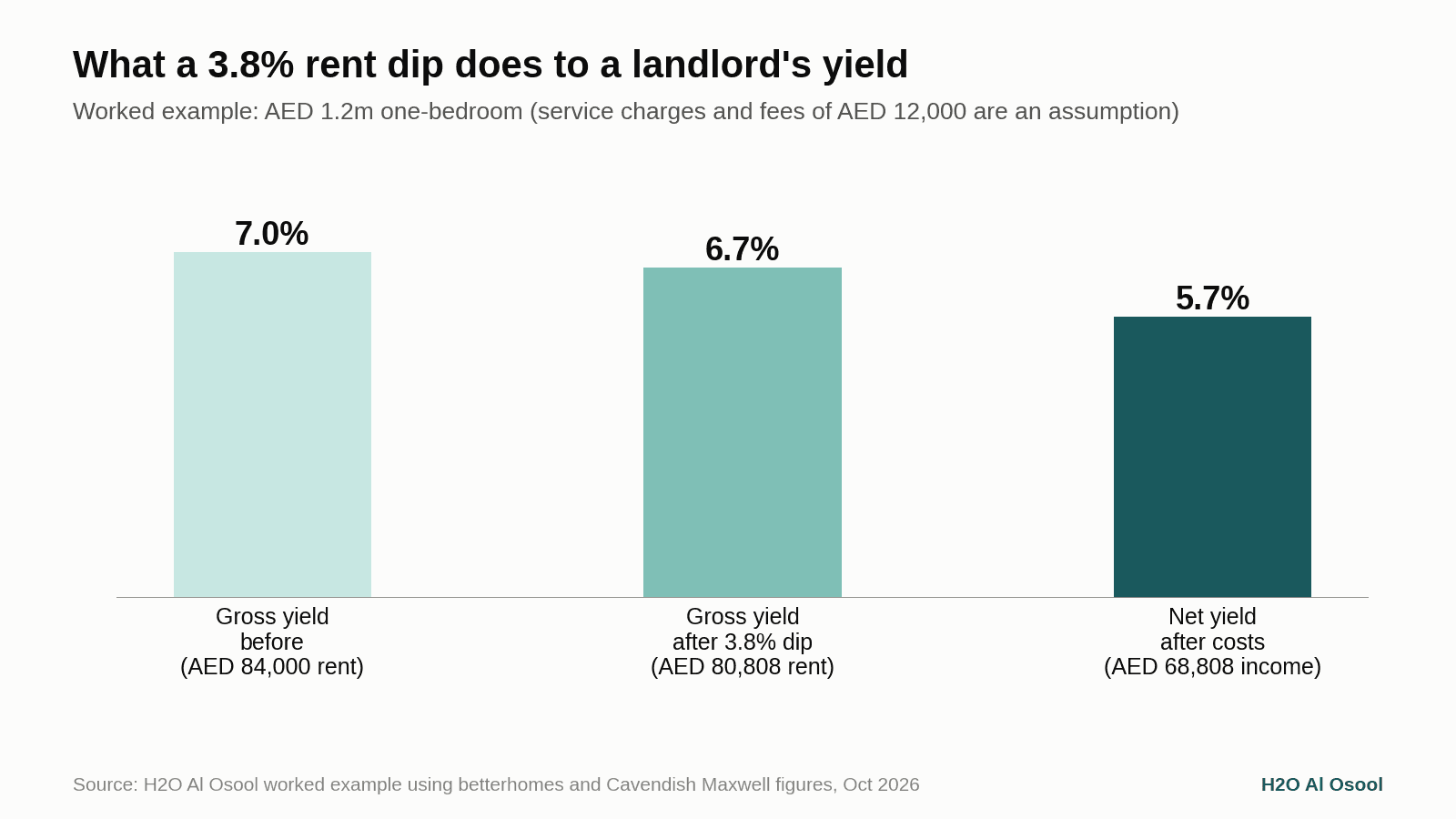
AED 1.2m one-bedroom: rent of about AED 84,000 gives a 7% gross yield. A 3.8% dip cuts rent to about AED 80,800 (6.7% gross). After AED 12,000 of assumed service charges and fees, net income is about AED 68,800, or 5.7%. Run it on your own numbers before holding out for a higher rent.
2. Dubai's economy in H1: where tenants' jobs are growing
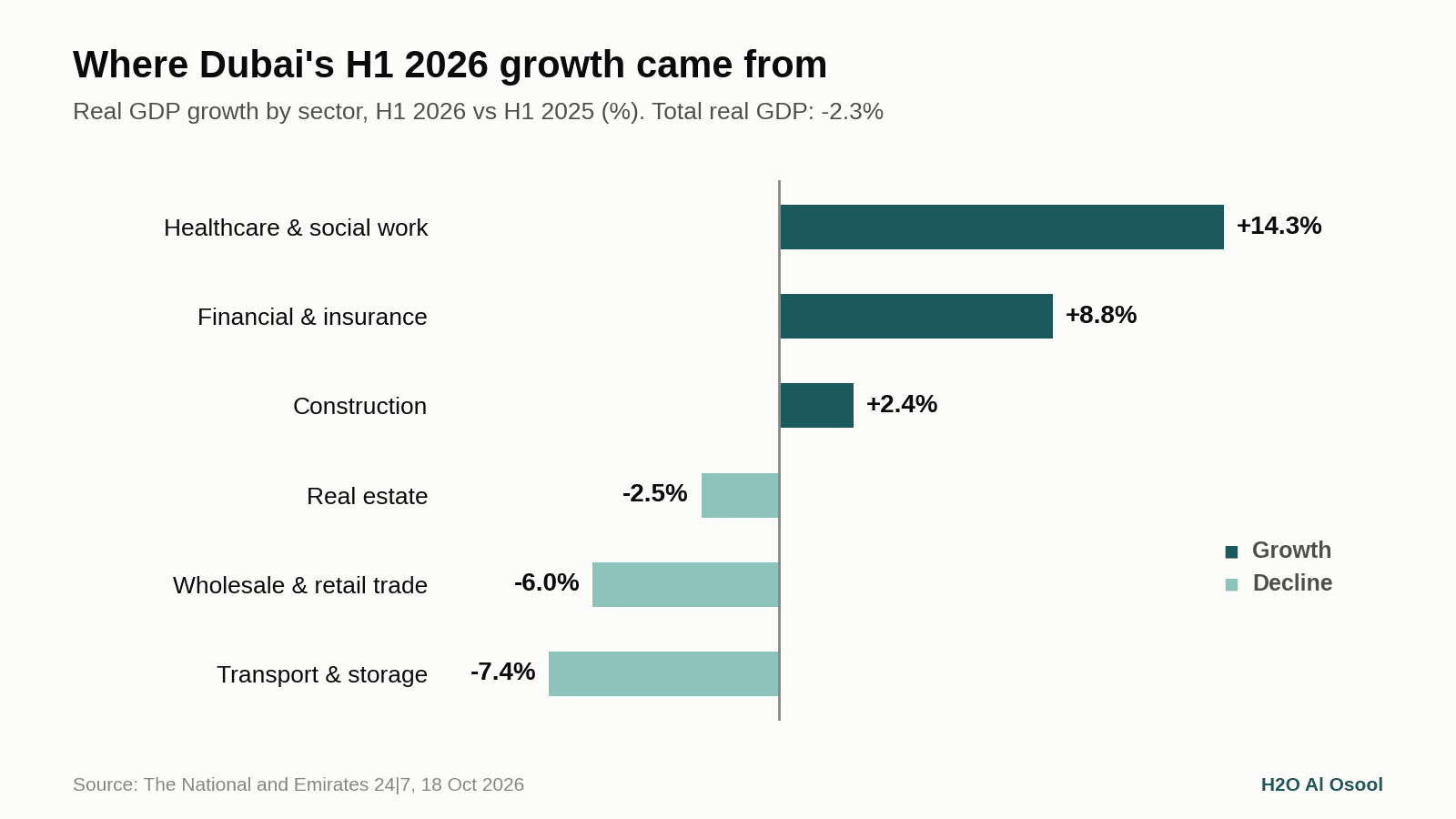
Reports from The National and Emirates 24|7 on 18 October put Dubai's real GDP at AED 473bn in the first half, down 2.3% from AED 484bn a year earlier. At current prices GDP was AED 505bn, up 0.2%. The National links the slowdown to the Iran war, which it says began on 28 February. For landlords the mix matters more than the total. Financial and insurance activities grew 8.8% in real terms and now represent 14% of GDP. Healthcare and social work grew 14.3% and construction 2.4%. Wholesale and retail trade fell 6% and transport and storage fell 7.4%. Real estate itself was down 2.5% in constant prices but up 5.4% at current prices, at 11.8% of real GDP (Emirates 24|7). Separately, the S&P Global UAE PMI for September (released 5 October) was 55.3, unchanged from August's 20-month high. Readings above 50 indicate expansion in the non-oil private sector.The headline and the detail
3. A week in the land registry: 12 to 16 October
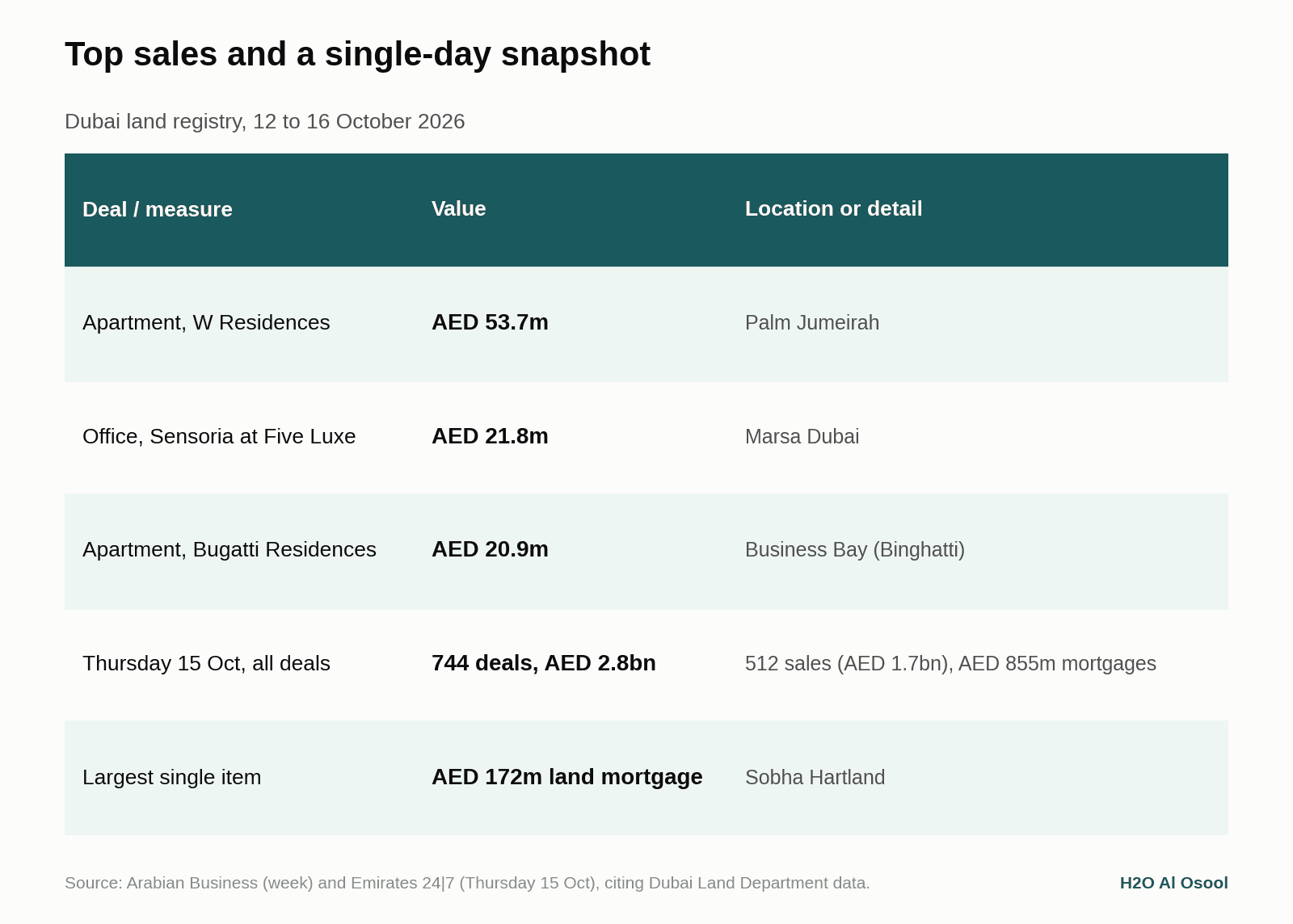
Arabian Business, citing Dubai Land Department data, reported AED 13.47bn in total transactions for 12 to 16 October. Sales were AED 8.59bn across 2,676 transactions, and mortgages were AED 3.72bn. By our arithmetic, sales were about 64% of the week's total value and mortgage registrations about 28%. The top sales were an AED 53.7m apartment in W Residences, Palm Jumeirah, an AED 21.8m office in Sensoria at Five Luxe, Marsa Dubai, and an AED 20.9m apartment in Bugatti Residences by Binghatti, Business Bay.The numbers
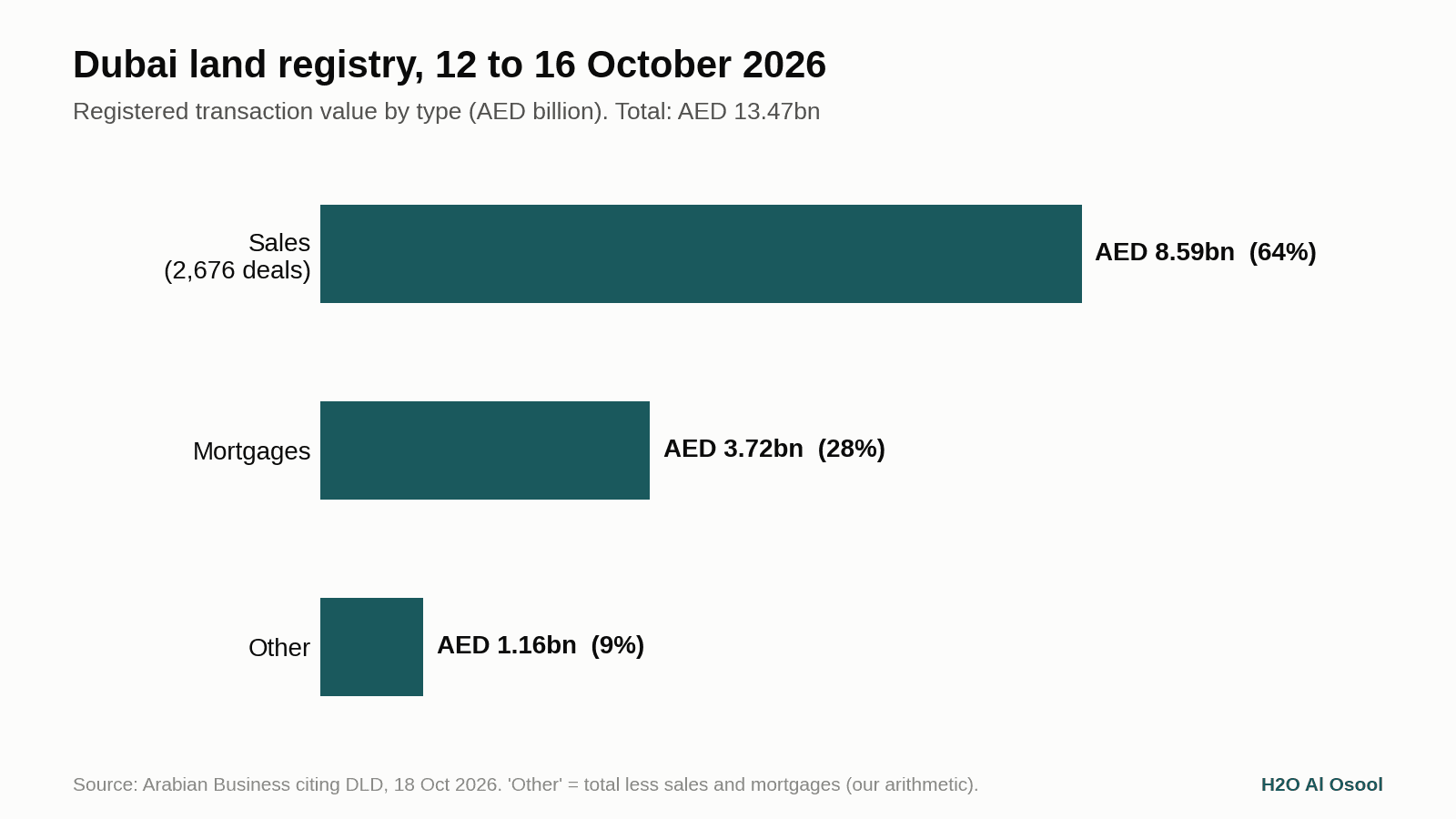
Total transactions: sales of AED 8.59bn across 2,676 deals (about 64%) and mortgages of AED 3.72bn (about 28%), per Dubai Land Department data reported by Arabian Business.
Emirates 24|7 reported that on Thursday 15 October there were 744 deals worth AED 2.8bn, including 512 sales worth AED 1.7bn and AED 855m of mortgages. The biggest item was a AED 172m land mortgage in Sobha Hartland.A single-day view
A mortgage share near 28% of weekly value suggests many buyers still rely on bank finance. If you plan to sell to an end user, lenders' valuations can cap what a buyer can pay, so price your exit against recent registered sales in your own building, not trophy deals on Palm Jumeirah.
4. The handover pipeline that will shape 2027 rents
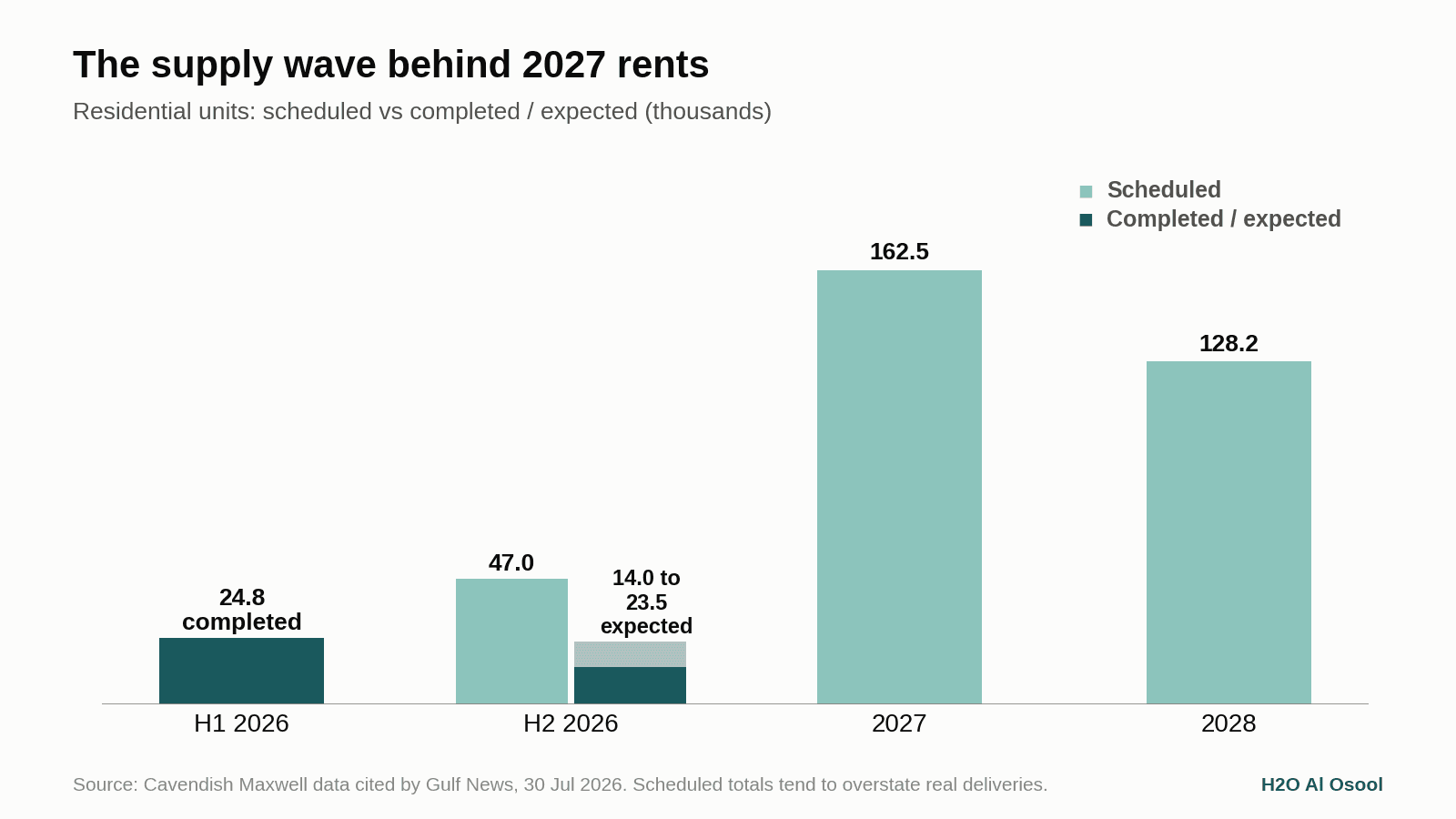
This is background from late July, but it is the best available guide to supply. Cavendish Maxwell data cited by Gulf News on 30 July showed 24,800 homes completed in H1 2026, with about 47,000 units scheduled for H2. Actual H2 handovers were expected to be between 14,000 and 23,500. The scheduled pipeline stands at 162,500 units for 2027 and 128,200 for 2028. Scheduled figures tend to overstate what is delivered, but even the lower range means more rental stock arriving.
If two new towers near your building complete in 2027, developers and first owners will compete for tenants with move-in incentives. Consider a longer lease at a slightly lower rent now, instead of risking a vacancy when competing listings appear.

Landlord and buy-to-let checklist
- Price to the building, not the city. Pull recent rents for the same layout and floor band.
- Value tenant quality. A reliable tenant for 12 months can beat a higher asking rent that sits vacant for six weeks.
- Know your net yield. Include service charges, maintenance and agent fees, not only gross rent.
- Watch sector headlines. Finance and healthcare growth supports different districts than trade and transport weakness.
Conclusion and your next step
The week's message is not that demand has vanished. People keep arriving and searching, finance and healthcare keep growing, and deals keep registering. What has changed is that tenants have more bargaining power as supply rises. Landlords who price to the building and plan for vacancy tend to cope better than those who anchor on last year's rent. Your next step this week: collect the asking rents of three comparable units in your building or your target building, then recalculate your net yield at the lowest of the three. If the numbers still work, you have a buffer. If they only work at the highest rent, treat the investment as riskier than the headline yield suggests. Disclaimer: this briefing is for general information only and is not financial, legal or investment advice. Figures are as reported by the sources listed below. Please verify before acting.
Sources
Dubai ready-home sales jump 16% as buyers shift away from off-plan properties (Khaleej Times) Dubai's economy reaches Dh473bn in first half of 2026 as key sectors expand (The National) Dubai property market Thursday: Dh2.8 billion across 744 deals (Emirates 24|7) S&P Global UAE PMI News Release, September 2026 (S&P Global) Dubai Property Market 2026: 24,800 New Homes Boost Supply as Prices and Rents Ease (Gulf News)